


Fishing for answers and testing the waters
How one UC Davis student turns a question about animal physiology into innovative immune research
Mikaila Hishaw, a fourth-year marine and coastal science major from Tucson, Arizona, arrived at UC Davis with plans to become a veterinarian. She soon discovered that research offered not just a new way to work with animals but also an avenue to explore her curiosity beyond the classroom.

From Labs to Lives
From Labs to Lives is a UC Davis–wide awareness campaign that highlights the critical role of federal funding in advancing research. Federal support not only fuels scientific discovery but also shapes the next generation of researchers whose work changes lives.
"Funding opens the doors for the driven and curious to become scientists. Loss of Maximizing Access to Research Careers program funding meant a sudden stop to my initial research plans. If science funding continues to decline, there are fewer avenues available for students to conduct independent research. When students lose their curiosity, we lose their solutions."
— Mikaila Hishaw
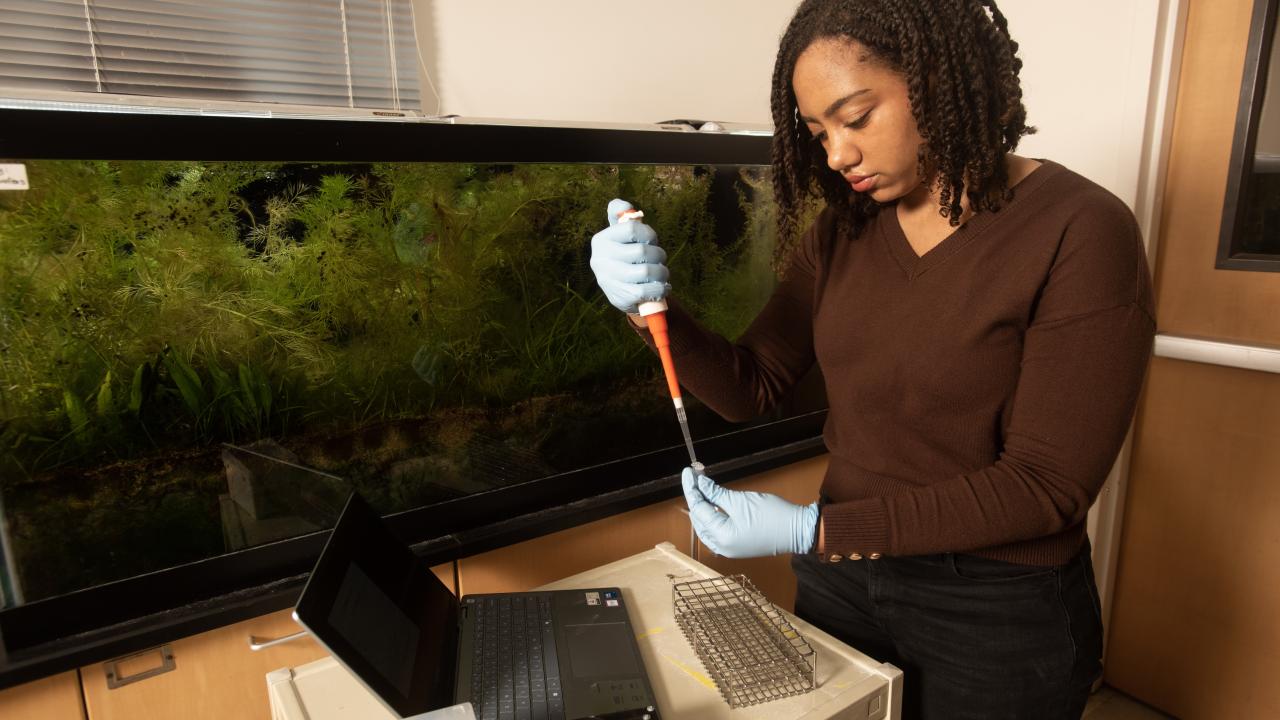
Hishaw conducts research at the UC Davis Aquaculture Cooperative Extension with the Gross Lab, where she studies immune function in white sturgeon — a commonly farmed fish, raised for human consumption. Her focus is leukocyte coping capacity, a measure of how white blood cells activate and suppress an oxidative burst, a defense response that helps fight infection. She examines whether certain commercial diets trigger inflammation that weakens that response, which in turn leaves fish more vulnerable to disease.
“Commercial diets exist for white sturgeon, but researchers continue to study more sustainable alternatives,” Hishaw said. “Multiple labs have explored this over the last 40 years. The work I conduct marks my little chapter in that long journey.”
Curiosity that leads to the lab
Hishaw’s path to research began her first year at UC Davis after a general education animal science course got her thinking about human-animal relationships. Regular visits to office hours that started with lecture questions turned into deeper back and forth discussions between student and professor.
Later in the quarter when the course’s aquaculture unit was introduced, Hishaw scheduled a conversation with her professor to learn more. That meeting led to an introduction to a colleague studying fish — the project’s principal investigator, Jackson Gross.
“I knew pretty quick that it was the right fit,” Hishaw said. “I felt supported and respected as both a student and a researcher.”
That sense of belonging translated into meaningful responsibility in the lab and ultimately led to her independent research project on white sturgeon.
“When expectations are clear and students commit over time, they become real contributors who strengthen consistency and day-to-day progress on projects,” Gross said. “Mikaila has grown from an enthusiastic undergraduate researcher into a highly capable junior scientist who takes ownership of complex work.”
When necessity drives innovation
As her work in the lab expanded, fellowship funding restrictions blocked the purchase of new equipment and created an obstacle. Her project required a luminometer — a device that measures light released during chemical reactions to track immune responses — the cost of which can reach $8,000. Rather than pause the study, she searched for another solution.
She reached out to labs across the Davis campus to see what resources she could gather. Over the course of a summer, she partnered with a graduate student who held a 3D template for a similar tool. Together they reviewed code, transferred design files to the campus printing facility and assembled the device piece by piece. Trial runs exposed flaws. Adjustments followed. The final version produced usable data that kept the project moving forward.
What first appeared as a setback ultimately prepared her for an unexpected opportunity. Last year the California Department of Fish and Wildlife reached out to her lab to gain insight on techniques she developed that they wanted to use for fish conservation efforts.
“I’ve learned that research rarely follows a straight path, but that’s how you get to the answers you need,” Hishaw said. “I was recently admitted to a combined veterinary and doctoral degree program at Cornell University, which will allow me to learn to care for animals and continue to find solutions that strengthen their care.”
This story is one of four profiles that showcase the undergraduate student research experience at UC Davis. Read the other three research pieces on the UC Davis Enrollment Management website.